HOT CREEK: A SPECIAL PLACE FOR ANGLERS
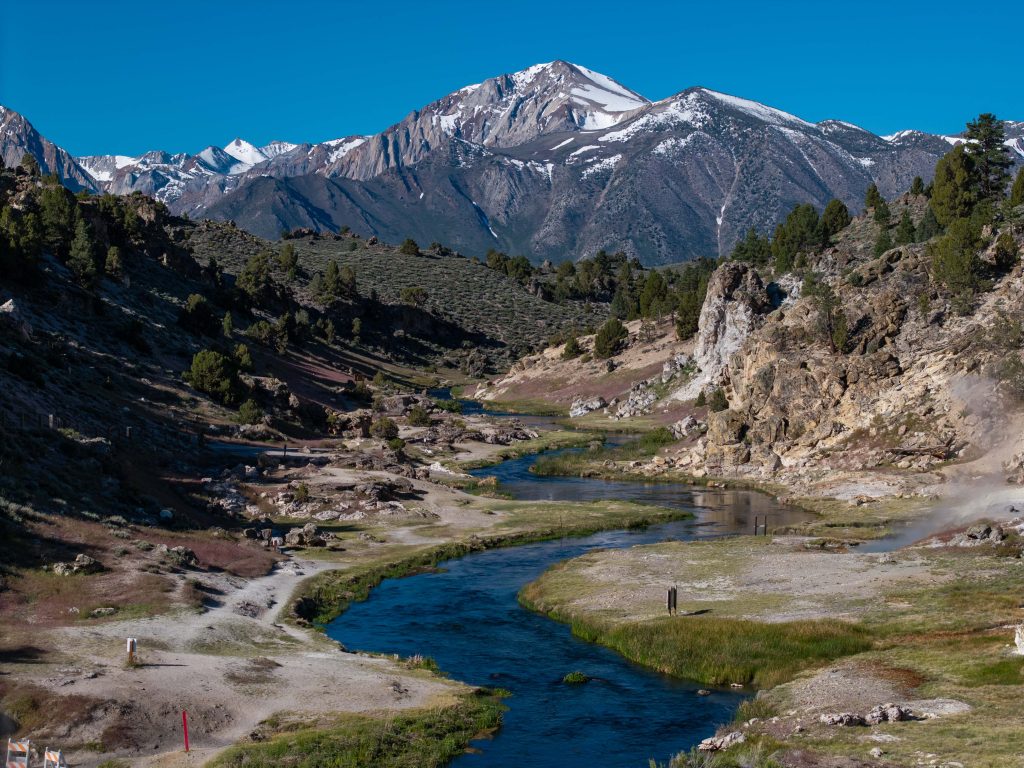
Hot Creek needs no introduction to anglers. Nestled in a dramatic volcanic canyon just south of Mammoth Lakes and a short drive north of Bishop, Hot Creek is one of the most revered wild trout streams in California. Despite its modest size, this small spring creek punches far above its weight, combining unique thermal geology with a legendary reputation that attracts fly anglers from across California and the world. The creek is primarily a spring creek fed by water bubbling up from volcanic rock at a remarkably consistent 60°-69°F. It merges with Mammoth Creek, which contributes cold, oxygen-rich Sierra snowmelt, and the Upper Owens River before flowing into Crowley Lake. The highly alkaline mineral-rich water supports dense beds of aquatic vegetation teeming with scuds, snails and insects. The creek snakes through a breathtaking volcanic gorge, framed by the peaks of the Sierra Nevada to the west and the Glass Mountains to the east. Steam vents and bubbling turquoise pools at the adjacent Hot Creek Geological Site add a scenic and prehistoric character to the landscape.
In 1980, Hot Creek became one of the first streams designated as a Wild Trout Water area by the State of California. It boasts a population of wild brown and rainbow trout, with wily trophy fish that sometimes push past the 20-inch mark. Because of its reputation, the trout in Hot Creek often see lots of angling pressure. Combined with clear, slow moving water, the fish are remarkably educated and easily spooked. Successful angling usually requires near flawless presentations, perfect drifts, long delicate leaders (~7X), and stealthy, low-profile stalking along the banks. To preserve this fragile and precious ecosystem, the public sections are strictly catch-and-release only, using artificial flies and barbless hooks only. Wading is highly discouraged in order to protect the delicate aquatic weed beds that line the creek and prevent the spread of invasive species such as the New Zealand mud snail.
Anyone who has cast a line there knows this unique fishery is not easy but can be tremendously rewarding: Hot Creek is truly a special place for fly anglers, and a rare gem in California.
WHAT IS THE POTENTIAL MINING ACTIVITY PLANNED FOR HOT CREEK?
The United States Forest Service (“USFS”) recently announced that KORE Mining, a Vancouver, Canada based “exploration stage company” whose stock trades on a Canadian stock exchange known as the TSX Venture Exchange, has re-submitted a proposal for exploratory drilling for gold and silver at numerous locations near and at Hot Creek. Recent reporting by SFGATE states that the USFS states it has “accepted their plan and are conducting the appropriate NEPA steps now.”
According to a revised preliminary economic assessment – technical report prepared by KORE in 2021, the project “is planned to be mined using conventional open pit mining methods.” The current proposal by the Canadian mining company mirrors their last project proposal, with plans for up to 36 core holes from twelve (12) large drill pads adjacent to Hot Creek across from the Hot Creek Fly Fishing Ranch. KORE’s 2021 operations plan proposed drilling 1,400 feet down with a core drill that would use approximately 4,000 gallons of water per day. The drilling would utilize heavy machinery and continue 24 hours a day, 7 days a week, with night lighting until they finish a drill hole and then move on to the next spot. A drill hole is estimated to take 7-10 days. Roads will need to be constructed to the drill pads. KORE states that it would reseed the drill pads and temporary roads at the conclusion of the project. KORE has proposed to use cyanide heap leaching to extract gold.
I THOUGHT HOT CREEK MINING HAD BEEN STOPPED, WHAT HAPPENED?
KORE Mining submitted a similar proposal to conduct exploratory drilling at Hot Creek in 2020. A group of conservation organizations challenged the USFS’s approval of the project under the National Environmental Policy Act (“NEPA”). In a decision on May 21, 2024 (Friends of the Inyo v. United States Forest Service, Case No. 23-15492), the United States Court of Appeals for the Ninth Circuit reversed and remanded the district court’s grant of summary judgment in favor of KORE and the USFS. The Ninth Circuit determined that the USFS had violated NEPA when it relied on two categorical exclusions for a single project to avoid otherwise required environmental reviews. That ruling effectively reversed USFS approval of the project under the then-current laws.
Following an Executive Order in 2025 (“Unleashing American Energy”), new administrative rules were implemented by the Council on Environmental Quality (“CEQ”). Updated CEQ guidance released on April 9, 2026 allows for broadened use of categorical exclusions to avoid previously required environmental assessments or environmental impact statements under NEPA. Among the changes is that public notice and comment opportunities are no longer required when issuing or revising these categorical exclusions. This means that many of the previous environmental protections that would have applied to KORE’s mining application have been removed or significantly reduced. In regards to this specific project, the USFS is not required to have a public comment period, limiting public input, and because there is now a more liberal use of categorical exclusions allowed, KORE’s application can be exempted from environmental review requirements.
WHAT IS THE POTENTIAL MINING ACTIVITY PLANNED FOR HOT CREEK?
The United States Forest Service (“USFS”) recently announced that KORE Mining, a Vancouver, Canada based “exploration stage company” whose stock trades on a Canadian stock exchange known as the TSX Venture Exchange, has re-submitted a proposal for exploratory drilling for gold and silver at numerous locations near and at Hot Creek. Recent reporting by SFGATE states that the USFS states it has “accepted their plan and are conducting the appropriate NEPA steps now.”
According to a revised preliminary economic assessment – technical report prepared by KORE in 2021, the project “is planned to be mined using conventional open pit mining methods.” The current proposal by the Canadian mining company mirrors their last project proposal, with plans for up to 36 core holes from twelve (12) large drill pads adjacent to Hot Creek across from the Hot Creek Fly Fishing Ranch. KORE’s 2021 operations plan proposed drilling 1,400 feet down with a core drill that would use approximately 4,000 gallons of water per day. The drilling would utilize heavy machinery and continue 24 hours a day, 7 days a week, with night lighting until they finish a drill hole and then move on to the next spot. A drill hole is estimated to take 7-10 days. Roads will need to be constructed to the drill pads. KORE states that it would reseed the drill pads and temporary roads at the conclusion of the project. KORE has proposed to use cyanide heap leaching to extract gold.
WHY SHOULD I CARE?
The Crowley Fish Foundation recognizes that our country has energy exploration needs. The CFF does not oppose responsibly conducted and legal exploration activities, and defers to our government authorities on questions of mineral and energy policy. However, the Foundation recognizes the importance to balance these competing concerns with the equally important conservation and stewardship goals that will ensure our most precious natural public lands and resources will be maintained. Our mission is to keep Crowley Lake and its tributaries (including Hot Creek) as world-class fishing destinations and to preserve them for future generations. The CFF actively supports the collection of scientific data through surveys designed to gather community input on fishing activity, fish presence and disappearance, and public perspectives on fisheries management across lakes throughout the Sierra Nevada, California. In addition, CFF assists with lake monitoring and scientific field sampling efforts. Through these activities, the Foundation helps ensure that angler perspectives are represented and considered in fisheries management decisions.
The CFF is concerned that the scope of the planned construction, drilling operations, generation of wastewater and other contaminants, and around-the-clock mining activity and noise may have a significant and permanent negative impact on the wild brown and rainbow trout that thrive and depend on the fragile and unique ecosystem that exists at Hot Creek. A fast tracked large scale open-pit exploratory drilling operation situated directly next to Hot Creek that is allowed to bypass adequate environmental reviews and public input may result in negative effects and impact on the creek, its related fisheries, and the local community. In addition, there are several other species that are currently endangered or candidates for listing as endangered species that may be significantly impacted. Two examples are the Bi-State Sage Grouse and the Tui Chub fish that are local only to the area, and already face dwindling populations. If the USFS approves this project under the new guidelines without allowing for any public input, none of these critically important risks and potential consequences will be properly reviewed and evaluated by experts who are not employed by the mining company. CFF supports public education and awareness of these important risks, and the ability of the community of concerned anglers to have input on these issues.
WHAT CAN I DO AND WHERE CAN I LEARN MORE?
Under the revised federal regulations, it appears the USFS may not intend to provide full disclosure of the mining proposal or hold a public comment period as they were previously required.
Accordingly, we encourage all concerned anglers, no matter where you are located, to tell the USFS administrators who are considering the KORE mining proposal what you think. The USFS has not invited or asked for input from anglers or anyone else in the community – that makes it even more important that every angler who cares about Hot Creek communicate their comments and concerns.
You do not have to live in the immediate community to get involved, every angler who has an interest in preserving this special fishery can and should make their voice heard by those who are considering approving the exploratory drilling at Hot Creek. It is up to you, and there may not be another opportunity to make your voice heard before the mining begins. Along with your concerns, we encourage you to share any personal stories and connection to Hot Creek that you may have. You can submit comments at the USFS Inyo National Forest comment portal here.
Don’t just take our word for it. Educate yourself about the KORE mining proposal for Hot Creek. Here are some relevant information sources:
* KORE Mining’s public announcement, preliminary economic assessment – technical report (from KORE’s website)
* Friends of the Inyo website and action alert
* No Hot Creek Mine coalition website
* Trout Unlimited website Places Worth Protecting: Hot Creek, California
The websites above are provided for informational purposes only. They do not necessarily reflect the views of the CFF.
Video credits: Taylor Erickson (used by permission)